Relaterade kurser
Visa samtliga kurser
The Architecture Of Physics Informed Machine Learning
Bridging Deep Learning With Real World Physical Laws
by Arsenii Drobotenko
Data Scientist, Ml Engineer
Mar, 2026・
6 min read


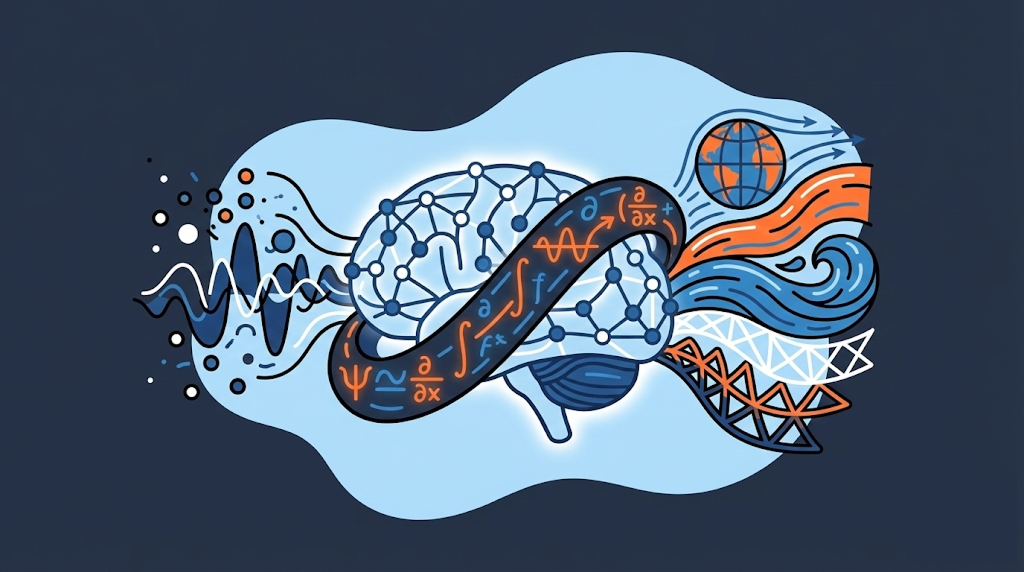
Artificial intelligence has conquered language, vision, and complex strategy games. However, when it comes to simulating the real physical world – like predicting fluid dynamics around an airplane wing or modeling climate shifts – traditional deep learning often hits a wall. Standard neural networks are fundamentally "black boxes" that learn patterns from data but have absolutely no innate understanding of gravity, thermodynamics, or the conservation of mass.
This gap has led to the rise of one of the most important architectural shifts in modern AI: Physics-Informed Machine Learning (PIML). By hardcoding scientific laws directly into the neural network, engineers are building systems that don't just guess based on past data, but actually understand the physical rules of the universe.
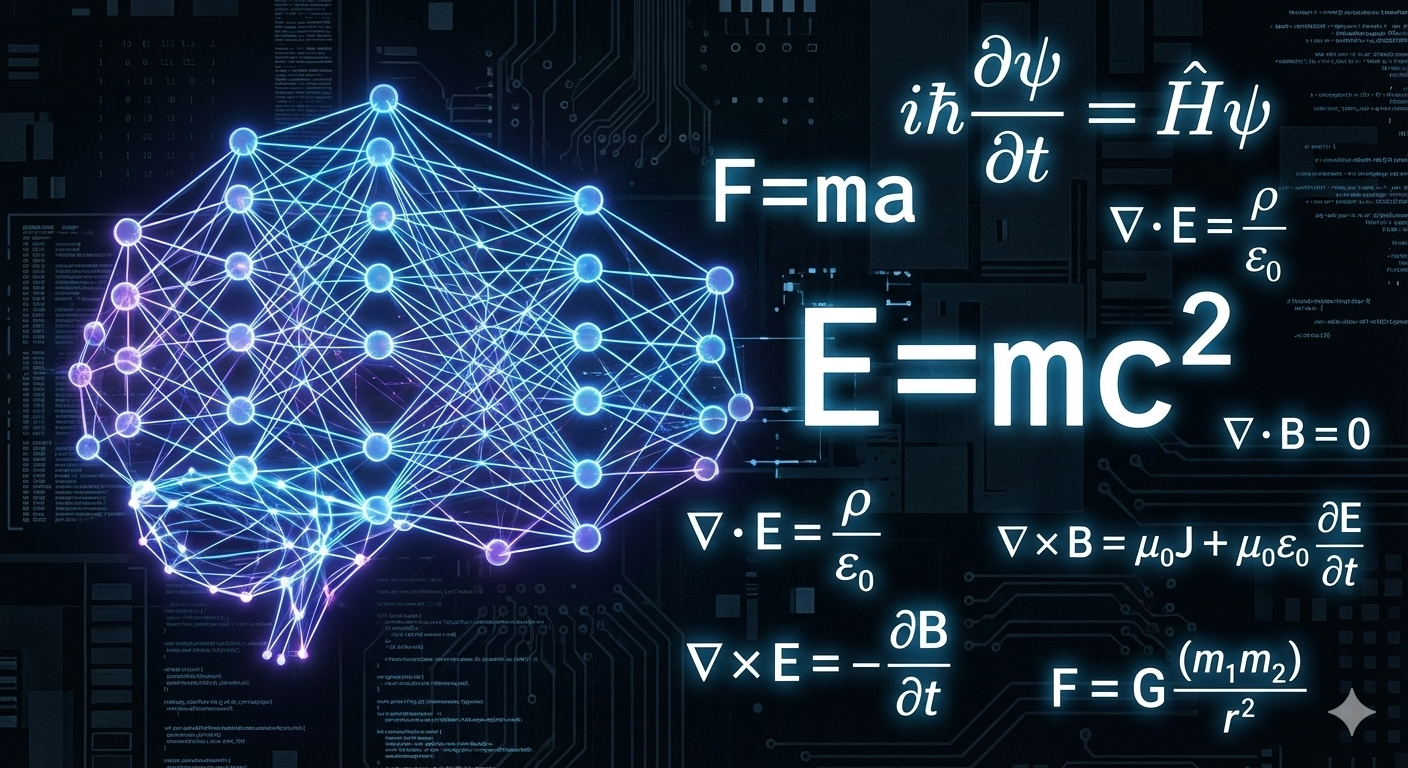
The Limits Of Purely Data Driven AI
Traditional machine learning models are entirely data-driven. If you want a model to predict how a bouncing ball behaves, you must feed it thousands of videos of bouncing balls. The model learns the statistical correlation of the pixels over time.
However, this approach has massive critical flaws in engineering and science:
- Data dependency: training a model requires massive amounts of high-quality, labeled data, which in scientific fields is often too expensive or impossible to gather;
- Physical hallucinations: because standard AI doesn't know physics, it can easily predict an outcome that defies the laws of nature. A model might predict that a fluid can compress in a way that violates the conservation of mass, simply because that outcome statistically minimizes the mathematical error in its training loop;
- Poor generalization: standard models fail catastrophically when asked to predict scenarios outside their training data.
Run Code from Your Browser - No Installation Required

What Is Physics Informed Machine Learning
Physics-Informed Machine Learning, often implemented via Physics-Informed Neural Networks (PINNs), solves these problems by embedding mathematical physics directly into the AI's learning process.
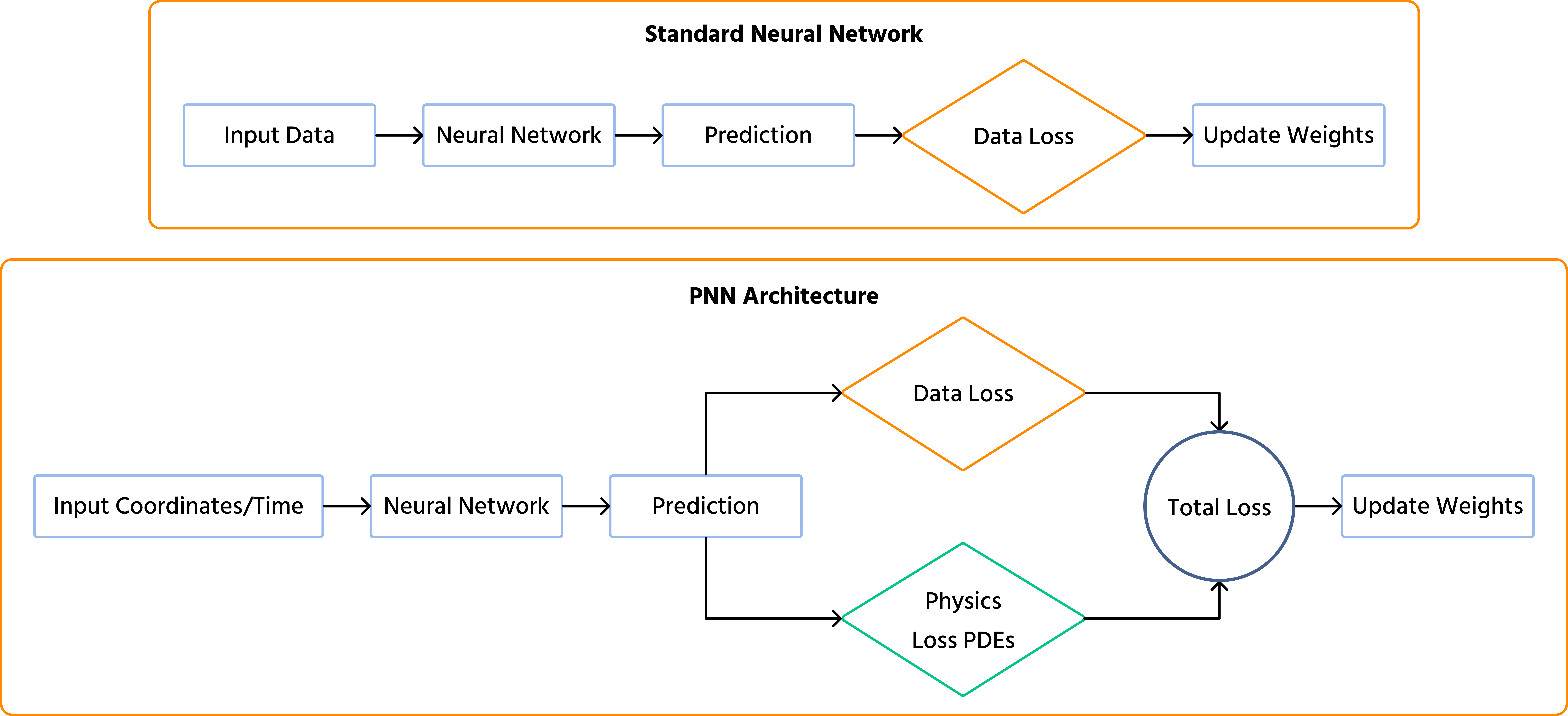
Instead of just calculating the difference between the AI's prediction and the actual data (the standard "loss function"), a PINN adds a "physics loss" to the equation. It calculates whether the AI's prediction violates known Partial Differential Equations (PDEs).
If the neural network predicts a state where energy is not conserved, the physics loss skyrockets, and the network is penalized. Recent breakthroughs, such as new methodologies developed by researchers at the University of Hawaiʻi, focus exactly on this: ensuring that AI outputs remain strictly within physically plausible boundaries even when processing highly chaotic and complex datasets.
Core Advantages Over Traditional Models
The integration of scientific laws into machine learning brings several transformative benefits to enterprise and research applications.
| Feature | Traditional Deep Learning | Physics-Informed ML (PIML) |
|---|---|---|
| Data Requirements | Extremely High (Millions of data points) | Low to Medium (Physics guides the learning) |
| Physical Accuracy | Unreliable (Prone to physical hallucinations) | Highly Reliable (Bound by physical laws) |
| Extrapolation | Poor (Fails outside training distribution) | Excellent (Physics laws remain true everywhere) |
| Explainability | Black Box | Mathematically verifiable outcomes |
Real World Applications
PIML is rapidly moving from academic research into enterprise deployment across various heavy industries
- Aerospace and automotive: simulating aerodynamics and fluid dynamics (CFD) in real-time, drastically reducing the need for expensive wind tunnel testing;
- Predictive maintenance: monitoring the structural integrity of bridges, pipelines, and factory machinery by combining limited sensor data with the physics of material fatigue;
- Climate and weather modeling: building "digital twins" of the Earth to predict extreme weather events with higher accuracy and lower computational costs than traditional supercomputer simulations.
Start Learning Coding today and boost your Career Potential
Conclusions
Physics-Informed Machine Learning represents the maturation of artificial intelligence. We are moving past the era of throwing massive amounts of data at a black box and hoping for the best. By marrying the pattern-recognition power of deep learning with the centuries-old mathematical laws of physics, PIML is unlocking a new generation of predictive models. These models are not just faster and more data-efficient; they are structurally guaranteed to make sense in the real world. For engineers and data scientists looking to the future, mastering PIML is no longer optional – it is the new baseline for applied physical AI.
FAQ
Q: Does PIML replace traditional neural networks?
A: No. PIML is a specialized architecture meant for scenarios where physical laws apply (like engineering, fluid dynamics, and materials science). For tasks like natural language processing, generating images, or analyzing financial data, traditional deep learning and LLMs remain the standard.
Q: What kind of math is required to build a Physics Informed model?
A: Building a PINN requires a strong understanding of calculus, specifically Partial Differential Equations (PDEs). You need to be able to express the physical laws of your specific problem (like the Navier-Stokes equations for fluids or the heat equation for thermodynamics) mathematically so they can be coded into the network's loss function.
Q: Why is this becoming popular right now?
A: While the concept has been around for a few years, we now have the computational power and advanced automatic differentiation tools (like TensorFlow and PyTorch) to efficiently calculate complex physics loss functions in real-time. As standard AI models hit the ceiling of what purely data-driven approaches can achieve, industries are turning to PIML to bridge the gap.
Var denna artikel nyttig?
Dela:
Var denna artikel nyttig?
Dela:
Relaterade kurser
Visa samtliga kurserSupervised vs Unsupervised Learning
Supervised vs Unsupervised Learning

by Andrii Chornyi
Data Scientist, ML Engineer
Dec, 2023・7 min read

Deep Learning vs Machine Learning
Deep Learning vs Machine Learning
by Andrii Chornyi
Data Scientist, ML Engineer
Dec, 2023・6 min read

Fine Tuning vs Feature Extraction in Transfer Learning
Fine Tuning and Feature Extraction
by Andrii Chornyi
Data Scientist, ML Engineer
Dec, 2023・7 min read

Innehållet i denna artikel
