Verwandte Kurse
Alle Kurse anzeigenHow to Design a System for 1 Million Users
Key Strategies for Building Scalable, High-Performance Systems for Large User Bases

by Eugene Obiedkov
Full Stack Developer
Feb, 2026・
9 min read


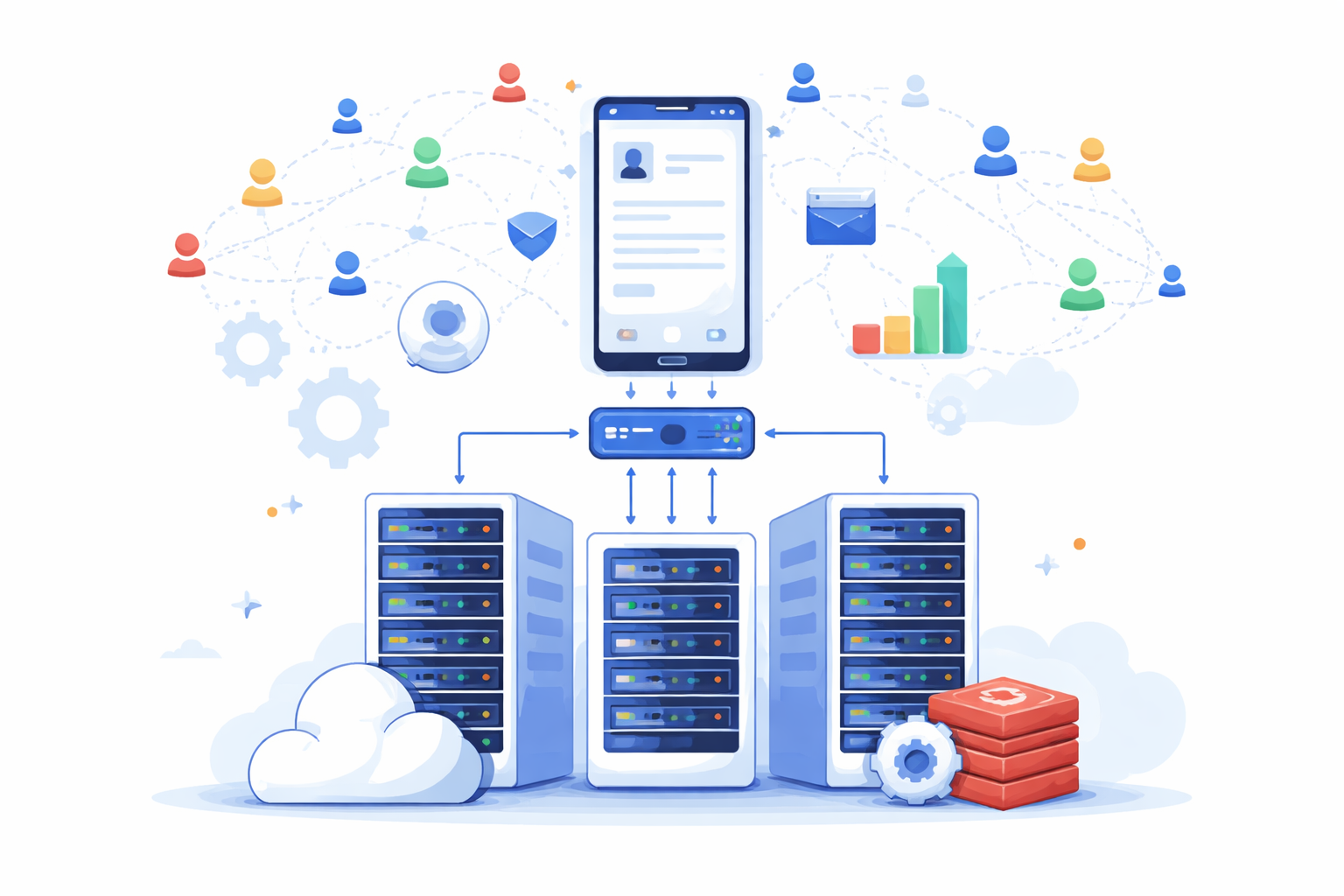
Building a system for one million users doesn’t mean you immediately need microservices, Kubernetes, or dozens of servers. Scalability starts with the right mindset: understanding load, identifying bottlenecks, and predicting how your system behaves under stress.
If the architecture is designed thoughtfully from the beginning, the system can grow smoothly instead of constantly breaking under pressure.
Start with Load: What Is RPS?
Before choosing technologies, you must understand your expected load. One of the key metrics here is RPS (Requests Per Second) — the number of HTTP requests your system handles every second.
This metric directly reflects how much traffic your backend must process.
For example, having 1,000,000 registered users does not mean all of them are online simultaneously. Suppose 50,000 users are active at the same time. If each user generates an average of 2 requests per second (scrolling a feed, refreshing data, clicking buttons), your system must handle:
50,000 × 2 = 100,000 RPS
That means 100,000 requests every second — which is serious traffic.
It’s also critical to consider peak load. Traffic is never evenly distributed. Evenings, product launches, or promotions can multiply your RPS several times.
Understanding RPS is the foundation of scalable system design.
Horizontal Scaling as the Foundation
When RPS grows, a single server eventually becomes a bottleneck. Vertical scaling (adding more CPU or RAM) works only up to a point. Hardware limits are real.
That’s why large systems rely on horizontal scaling — running multiple backend instances behind a load balancer that distributes traffic evenly.
A critical requirement here is a stateless backend.
Stateless means the server does not store user session data in its own memory between requests. If one instance fails, another can immediately take over without breaking the user experience. User state should live in a database, a cache (Redis), or a token (JWT).
A stateless architecture allows you to scale by simply adding more servers as RPS increases.
Run Code from Your Browser - No Installation Required

The Database: The Main Bottleneck
In most real-world systems, the database becomes the first serious bottleneck.
As RPS increases, the database struggles with too many concurrent connections, slow queries, locking issues, and missing indexes.
A common approach is separating read and write operations.
The primary database (master) handles writes, while read replicas handle read traffic. Since most systems perform far more reads than writes, this significantly reduces pressure on the primary node.
It’s also important to understand amplification. If your system handles 100,000 RPS, and each request triggers 3 database queries, that’s 300,000 database operations per second. Without optimization, this won’t scale.
Caching: Reducing Database RPS
One of the most powerful scalability tools is caching.
The goal of caching is simple: reduce the number of requests reaching the database.
For example, frequently accessed user profiles can be stored in Redis. Instead of hitting the database every time, the backend retrieves data from memory, which is dramatically faster.
This effectively lowers the real database RPS, even if your overall application RPS remains high.
In large systems, caching is not an optimization — it’s a requirement.
Additionally, static assets such as images, videos, and JavaScript files should be served via a CDN (Content Delivery Network). This prevents unnecessary load on your backend and significantly reduces overall RPS to application servers.
Asynchronous Processing and Queues
Not every operation must be processed within the HTTP request lifecycle.
For example, when a user registers, the system can immediately return a success response while sending the confirmation email through a background worker using a message queue.
This improves latency (response time) and stabilizes the system under high RPS.
If traffic spikes, queues help absorb sudden load increases, allowing workers to process tasks gradually instead of overwhelming the system.
Asynchronous design prevents slow operations from blocking request processing.
High Availability Under Heavy Load
The higher the RPS, the more frequently failures occur.
At 100 requests per second, rare bugs seem insignificant. At 100,000 RPS, even a tiny failure rate becomes constant.
That’s why scalable systems must include automatic instance restarts, health checks, retry mechanisms with limits, and circuit breakers for external services.
The system should degrade gracefully, not crash entirely.
Start Learning Coding today and boost your Career Potential
Conclusion
Designing a system for 1 million users is fundamentally about managing load correctly.
You must understand your RPS, predict peak traffic, scale horizontally, cache aggressively, and continuously monitor system health.
A scalable system does not happen by accident — it is intentionally designed from day one.
FAQ
Q: Do I really need to design for 1 million users from day one?
A: Not necessarily. Early-stage products should prioritize simplicity and speed of development. However, you should design with scalability in mind. Building a clean, modular, and stateless architecture from the start makes it much easier to scale later without a complete rewrite.
Q: What is RPS and why is it so important?
A: RPS (Requests Per Second) measures how many requests your system handles every second. It directly reflects system load. Understanding your expected and peak RPS helps you choose the right architecture, database strategy, caching layer, and scaling approach.
Q: How do I estimate my expected RPS?
A: Start by estimating the number of concurrent users and how many requests each user generates per second. Multiply those numbers to get an approximate RPS. Always account for peak traffic, which can be several times higher than average load.
Q: Is horizontal scaling always better than vertical scaling?
A: Horizontal scaling is generally more sustainable for high-traffic systems because it avoids hardware limits. Vertical scaling can help in early stages, but long-term scalability typically requires distributing load across multiple instances.
Q: When should I introduce caching?
A: As soon as you notice repeated reads for the same data or increasing database load. Caching is one of the most effective ways to reduce database RPS and improve response time. In high-traffic systems, caching is essential rather than optional.
Q: Do I need microservices to support 1 million users?
A: Not necessarily. A well-designed modular monolith can handle very high traffic. Microservices add operational complexity and should only be introduced when there is a clear need, such as independent scaling of components or large team ownership boundaries.
Q: What is the biggest bottleneck in scalable systems?
A: In most cases, the database becomes the primary bottleneck due to connection limits, slow queries, and locking. Optimizing queries, adding indexes, using read replicas, and implementing caching are key strategies to mitigate this.
Q: How important is monitoring in scalable architecture?
A: Monitoring is critical. Without visibility into RPS, latency, error rates, CPU, memory usage, and database performance, you cannot make informed scaling decisions. Scalability is an ongoing process driven by metrics.
Q: Should I optimize for peak traffic or average traffic?
A: You must design for peak traffic, not just average load. Systems often fail during sudden spikes. Using auto-scaling, caching, and asynchronous processing helps handle unpredictable traffic increases.
Q: What is the most common mistake when designing for scale?
A: Overengineering too early or, conversely, ignoring scalability completely. The best approach is incremental scalability: build simple, measure real load, identify bottlenecks, and scale intentionally based on data.
War dieser Artikel hilfreich?
Teilen:
War dieser Artikel hilfreich?
Teilen:
Verwandte Kurse
Alle Kurse anzeigenThe SOLID Principles in Software Development
The SOLID Principles Overview

by Anastasiia Tsurkan
Backend Developer
Nov, 2023・4 min read

30 Python Project Ideas for Beginners
Python Project Ideas
by Anastasiia Tsurkan
Backend Developer
Nov, 2023・5 min read

Top 3 SQL Certifications
How to Confirm Your SQL Skills

by Daniil Lypenets
Full Stack Developer
Sep, 2023・9 min read

Inhalt dieses Artikels
