Entity-Relationship Model. Relationships
Свайпніть щоб показати меню
Relationships in Databases
In relational databases, various relationships can be illustrated in diagrams.
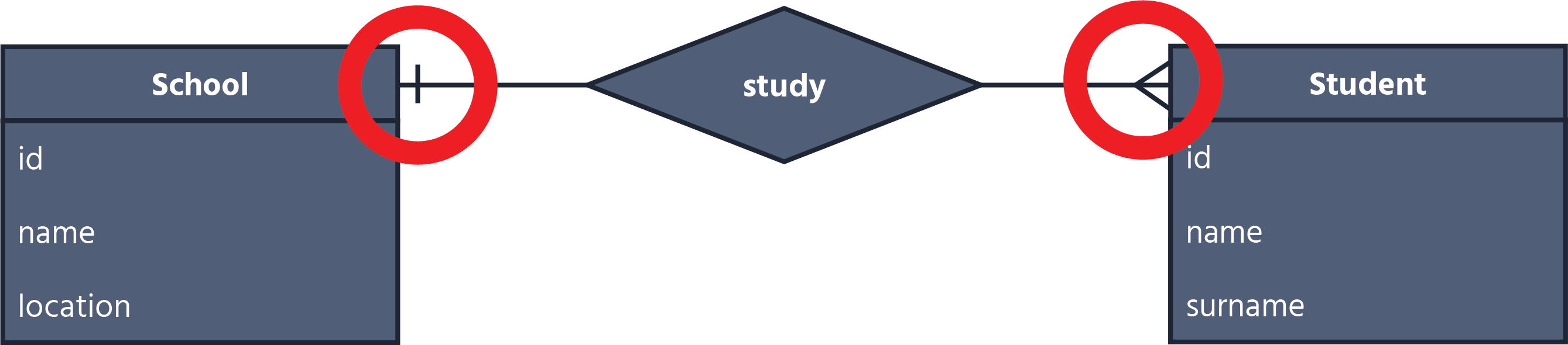
Different entities can have specific interdependencies, each defining how elements interact. An element might relate to multiple others or just one. This interaction is termed a relationship.
Relational databases capture these connections in diagrams.
Types of Relationships:
- One-to-One;
- One-to-Many;
- Many-to-One;
- Many-to-Many.
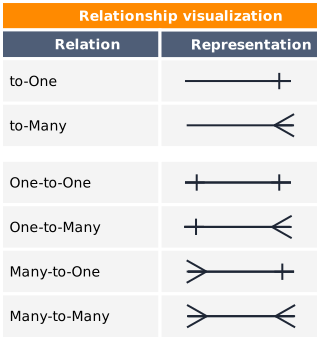
We'll dive deeper into these relationship types later, but for now, here's their representation:
Mandatory vs. Optional Relationships
Mandatory and optional relationships come with distinct markers: | (a line) for mandatory and o (a circle) for optional.
-
A mandatory relationship implies that a particular entity instance must have a connection to another entity;
-
An optional relationship means that an entity instance might have a link to another entity, but it's not obligatory.
Consider the following examples:
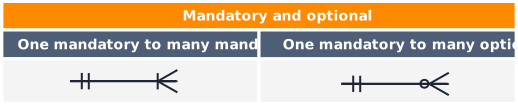
While mandatory and optional relationships might not be frequently used, it's crucial to recognize these markers.
1. Select all relationship types:
2. Choose marks:
Дякуємо за ваш відгук!
Запитати АІ

Запитати АІ

Запитайте про що завгодно або спробуйте одне із запропонованих запитань, щоб почати наш чат
