Notice: This page requires JavaScript to function properly.
Please enable JavaScript in your browser settings or update your browser.
Вивчайте Entity-Relationship Model | Моделі Баз Даних
Реляційні Бази Даних та Нормалізація

Entity-Relationship Model

Свайпніть щоб показати меню

Databases come in various sizes, comprising different numbers of tables and relationships. This is why we use diagrams when designing databases – they offer a visual representation of the database's structure.

Let's get acquainted with the most commonly used diagram in database design: the entity-relationship model (often abbreviated as ER model). For instance:
ERM Example%404x-8

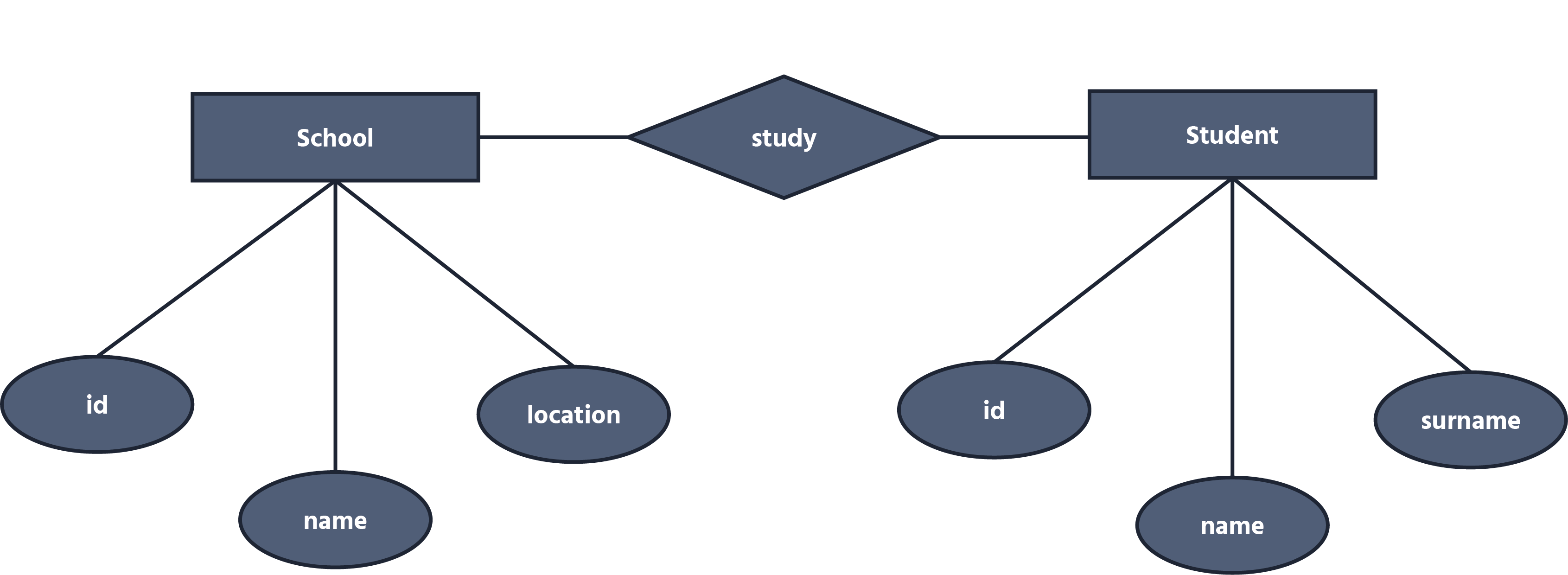
In this example, we have two entities: School and Student. The School entity boasts attributes like id, name, and location, whereas the Student entity features attributes such as id, name, and surname. There exists a relationship between the Student and School entities, which we label as "study".

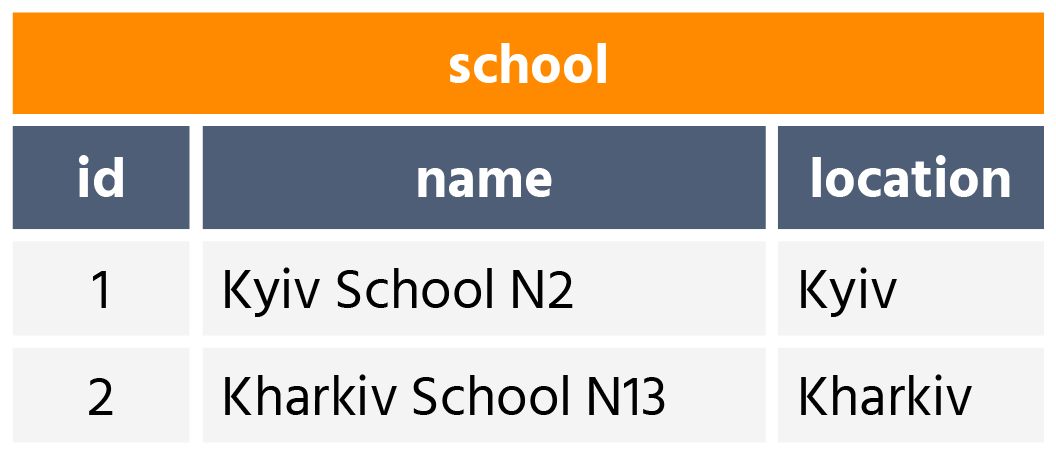
In tables of relational databases, this can be depicted using a foreign key:
school table%404x-8
student table%404x-8

The "study" relationship is captured using a foreign key (the school_id column in this case).

Such models are instrumental in crafting a coherent database structure.

Concepts

The ER model is underpinned by three essential concepts:

  • Entities: These can be tangible or abstract objects, like schools and students. Represented by a Rectangle;

  • Attributes: These are features or properties tied to entities. For instance, a school might have attributes like location or founding year, while a student might have age or group. Represented by an Ellipse;

  • Relationships: These signify the interactions or connections between entities or attributes. Represented by a Rhombus.

You can see the graphical representation of these elements in the image provided:

Shapes%404x-8

Modern Entity-Relationship Diagram Presentation

Given that attribute shapes can take up a significant amount of space on a diagram, there's an alternative representation:

ERM modern example%404x-8

In this format, you'll notice a single-column table. The header denotes the entity, while each row below corresponds to the attributes linked to that entity.

question-icon

Choose the shapes:

The Entity shape is .

The Attribute shape is
.

The Relationship shape is
.

Click or drag`n`drop items and fill in the blanks

Все було зрозуміло?

Як ми можемо покращити це?

Дякуємо за ваш відгук!

Секція 1. Розділ 3

Запитати АІ

expand

Запитати АІ

ChatGPT

Запитайте про що завгодно або спробуйте одне із запропонованих запитань, щоб почати наш чат

Entity-Relationship Model

Databases come in various sizes, comprising different numbers of tables and relationships. This is why we use diagrams when designing databases – they offer a visual representation of the database's structure.

Let's get acquainted with the most commonly used diagram in database design: the entity-relationship model (often abbreviated as ER model). For instance:

ERM Example%404x-8

In this example, we have two entities: School and Student. The School entity boasts attributes like id, name, and location, whereas the Student entity features attributes such as id, name, and surname. There exists a relationship between the Student and School entities, which we label as "study".

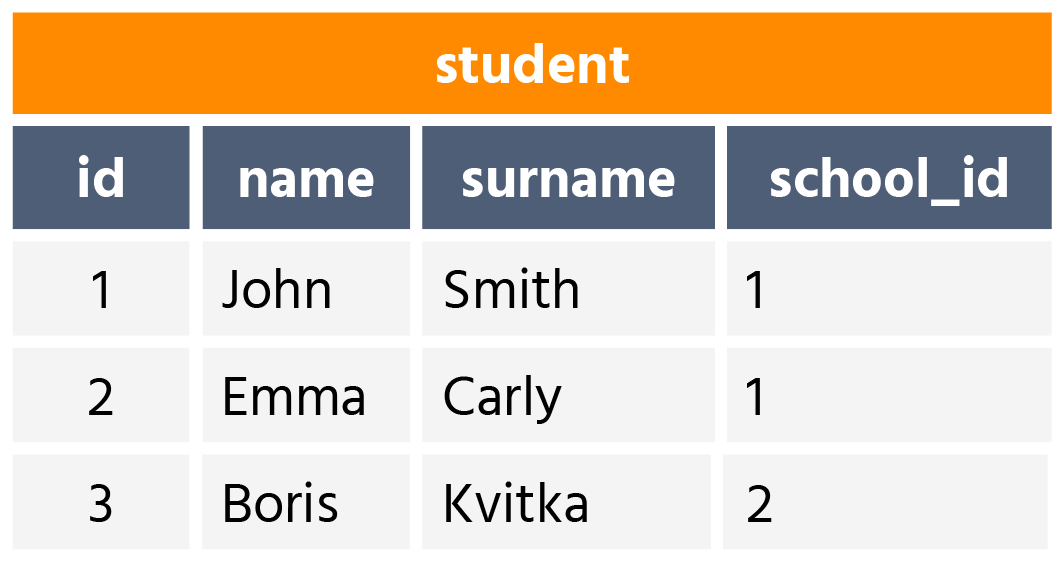
In tables of relational databases, this can be depicted using a foreign key:
school table%404x-8
student table%404x-8

The "study" relationship is captured using a foreign key (the school_id column in this case).

Such models are instrumental in crafting a coherent database structure.

Concepts

The ER model is underpinned by three essential concepts:

  • Entities: These can be tangible or abstract objects, like schools and students. Represented by a Rectangle;

  • Attributes: These are features or properties tied to entities. For instance, a school might have attributes like location or founding year, while a student might have age or group. Represented by an Ellipse;

  • Relationships: These signify the interactions or connections between entities or attributes. Represented by a Rhombus.

You can see the graphical representation of these elements in the image provided:

Shapes%404x-8

Modern Entity-Relationship Diagram Presentation

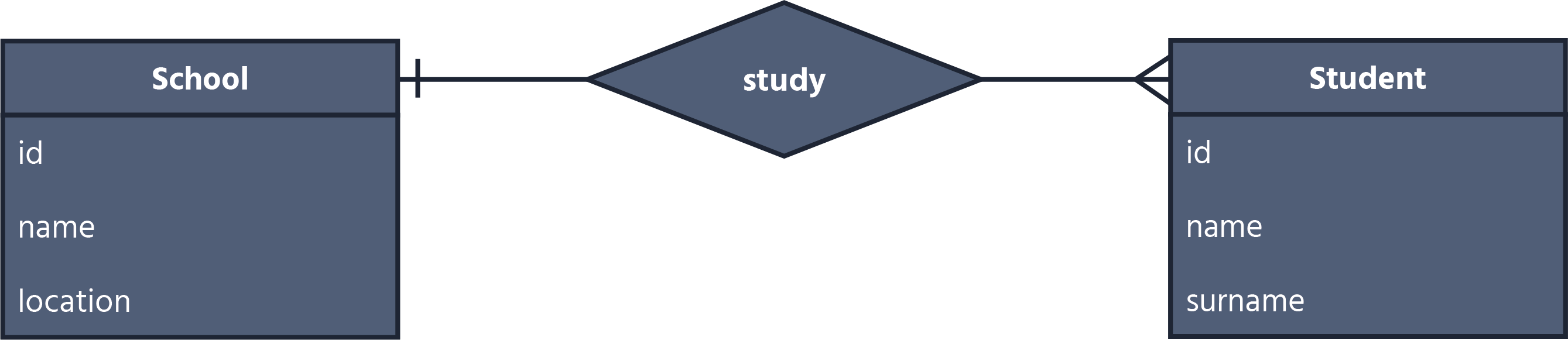
Given that attribute shapes can take up a significant amount of space on a diagram, there's an alternative representation:
ERM modern example%404x-8

In this format, you'll notice a single-column table. The header denotes the entity, while each row below corresponds to the attributes linked to that entity.

Все було зрозуміло?

Як ми можемо покращити це?

Дякуємо за ваш відгук!

Секція 1. Розділ 3
some-alt