How to Run the Program?
Свайпніть щоб показати меню

A compiler is a specialized program that translates human-readable C source code into machine code, which the processor can execute. This translation process enables your written instructions to become an executable file that the computer understands and runs.
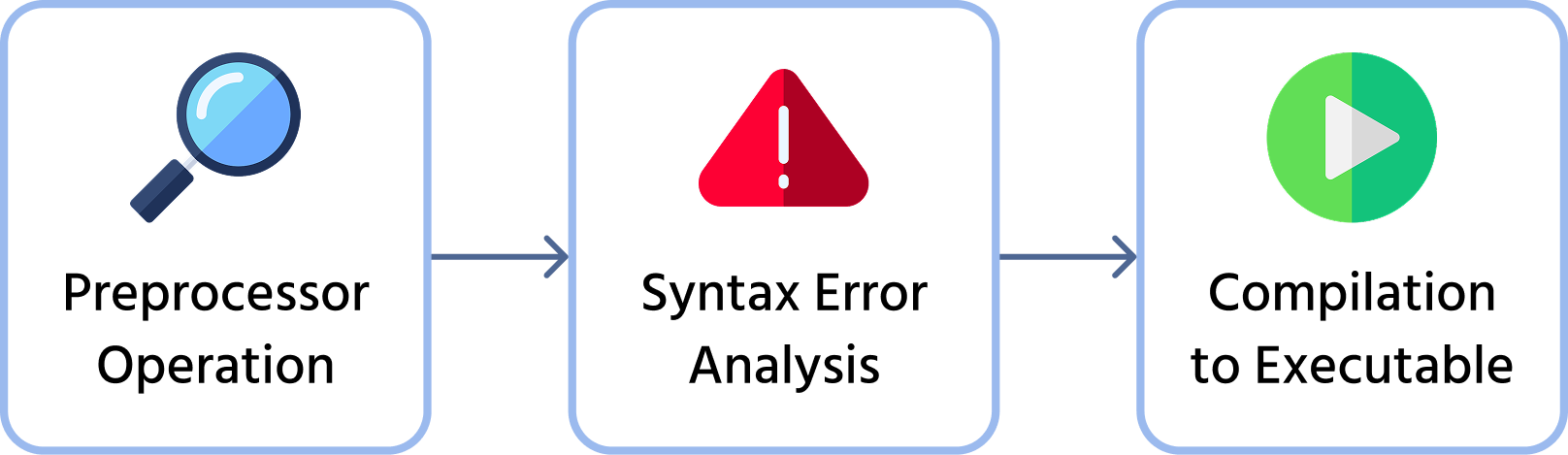
To transform our code into specific commands for the processor, you need a compiler. The compiler processes code sequentially, from top to bottom. The act of compilation goes through several stages:
-
Preprocessor Operation: all
#includedirectives are processed, integrating external files, libraries, and other required components into your program; -
Syntax Error Analysis: the compiler checks for syntax errors and halts the compilation if any mistakes are found, highlighting them for correction;
-
Compilation to Executable File: the program is translated into an executable file (e.g.,
.exeon Windows), allowing you to run it like any other application.
An executable file is simply a series of instructions (machine code) meant for the processor. For context, the phrase "Hello, c<>definity" in machine code might resemble a sequence.

program.exe
1201001000011001010110110001101100011011110010110000100000011000110011110000111 110011001000110010101100110011010010110111001101001011101000111100100100001
An intentional error was added to the code below to demonstrate how the C compiler detects and reports issues.

Main.c
12345678#include <stdio.h> int main() { printf("some text") // Error line return 0; }
The compiler expects a semicolon (;) at the end of the fifth line. Without it, the compiler doesn't recognize where the statement ends and treats return 0; as part of the same line. As a result, the error appears on the next line, even though the real issue is the missing semicolon after printf.
Main.c
12345678#include <stdio.h> int main() { ;; ;;;;;; printf("C language\n");;; ;return 0; ;;; }
The C compiler is quite forgiving with extra semicolons. While they may look odd, multiple ; are treated as empty statements and don't affect the program's behavior. The code will still compile and run without issues, but it's good practice to avoid unnecessary semicolons to keep your code clean and readable.
Дякуємо за ваш відгук!
Запитати АІ

Запитати АІ

Запитайте про що завгодно або спробуйте одне із запропонованих запитань, щоб почати наш чат
