
single
Working with Pointers
Sveip for å vise menyen
Using the reference operator & and the dereference operator *, we can create and work with pointers.
A pointer is a data type, just like int, char, or double.
The pointer is designed to store an address, which you can obtain using the & operator.
To declare a pointer, prepend it with the * character.

main.c
123int* intPointer; // Pointer to an `int` variable double* doublePointer; // Pointer to a `double` variable char* charPointer; // Pointer to a `char` variable
In essence, a pointer is a variable that holds the address of another object.
main.c
123int x = 100; // Variable int* pX; // Pointer to an `int` variable pX = &x; // `pX` now points to `x`

Typically, pointers are named by prefixing the letter p to the name of the object they're pointing to.
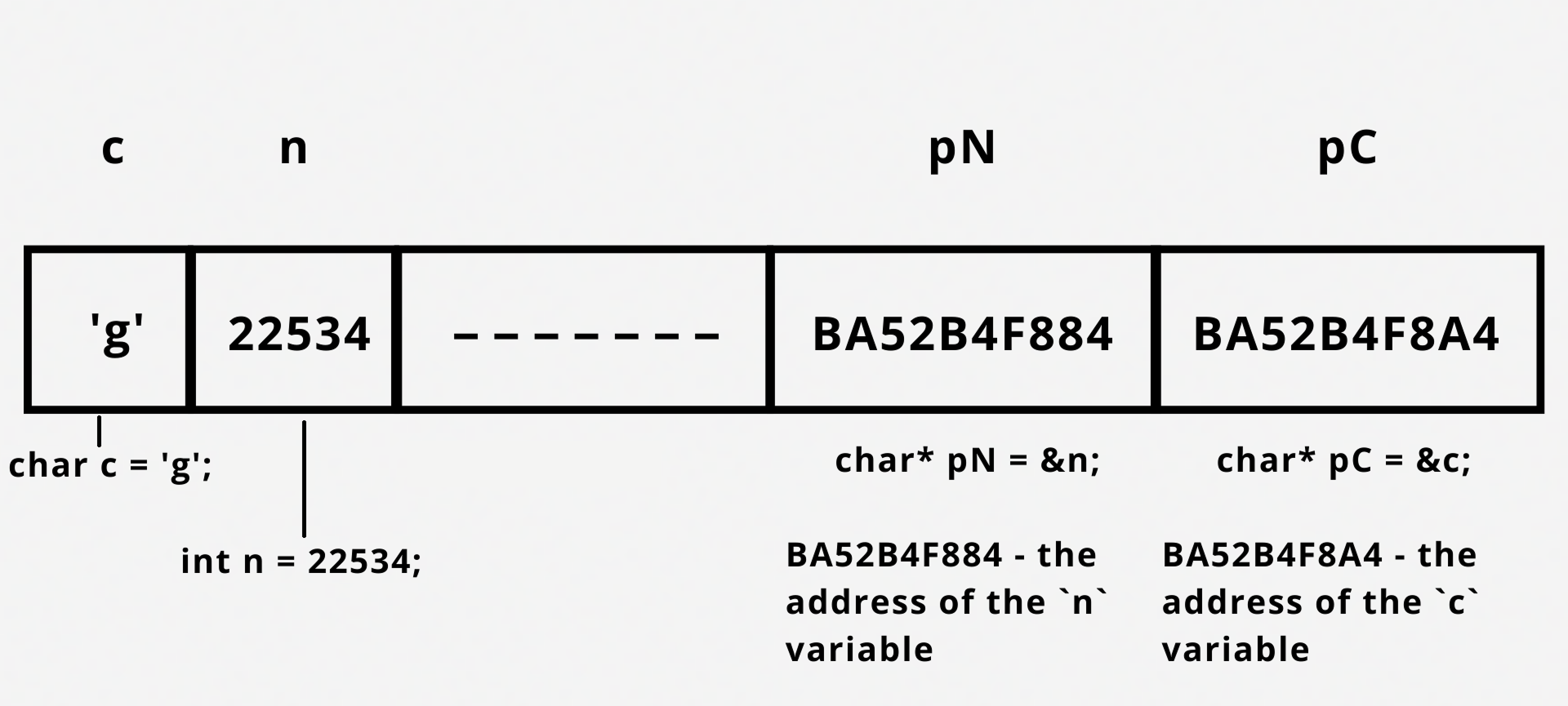
When you dereference a pointer, you access the value of the variable it points to.
Main.c
12345678910111213#include <stdio.h> int main() { int x = 22543; // Variable int* pX = &x; // `pX` is pointer to `x` printf("The value of `pX` is %p\n", pX); // Value of pointer `pX` printf("The value of `x` by pointer `pX` is %d\n", *pX); // Pointer dereference return 0; }
*(&variable) == *pVariable
If you attempt to dereference a null pointer, the compiler will raise an error:
Main.c
1234567#include <stdio.h> int main() { int* pX; printf("x = %p", pX); return 0; }
Sveip for å begynne å kode
Determine the size of int and double pointers.
Løsning
 Bytt til skrivebordet for virkelighetspraksisFortsett der du er med et av alternativene nedenfor
Takk for tilbakemeldingene dine!
single
Spør AI

Spør AI

Spør om hva du vil, eller prøv ett av de foreslåtte spørsmålene for å starte chatten vår
