Pooling Layers
メニューを表示するにはスワイプしてください
Purpose of Pooling
Pooling layers play a crucial role in convolutional neural networks (CNNs) by reducing the spatial dimensions of feature maps while retaining essential information. This helps in:
- Dimensionality reduction: decreasing computational complexity and memory usage;
- Feature preservation: keeping the most relevant details for further layers;
- Overfitting prevention: reducing the risk of capturing noise and irrelevant details;
- Translation invariance: making the network more robust to variations in object positions within an image.
Types of Pooling
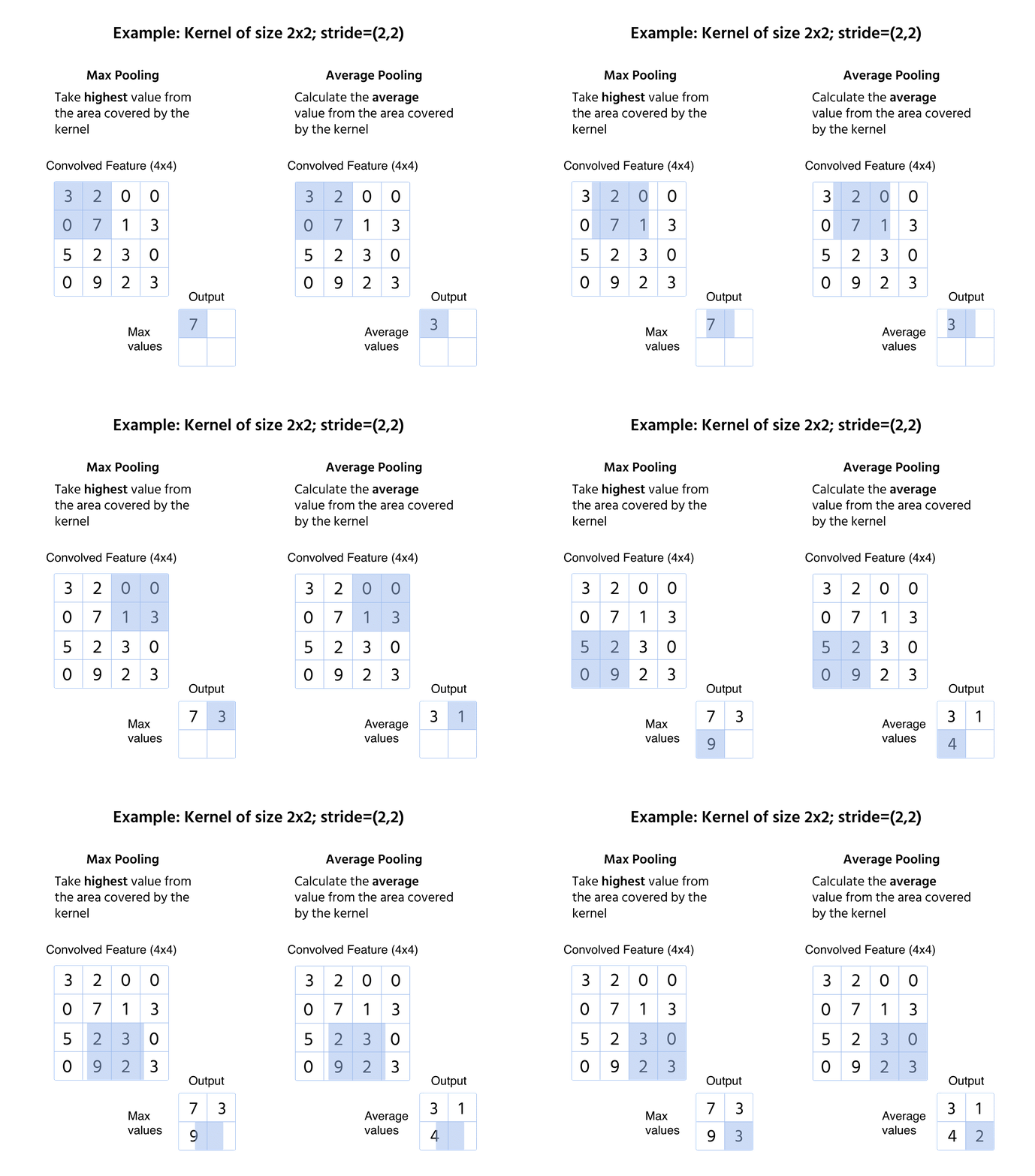
Pooling layers operate by applying a small window across feature maps and aggregating values in different ways. The main types of pooling include:
Max Pooling
- Selects the maximum value from the window;
- Preserves dominant features while discarding minor variations;
- Commonly used due to its ability to retain sharp and prominent edges.
Average Pooling
- Computes the average value within the window;
- Provides a smoother feature map by reducing extreme variations;
- Less commonly used than max pooling but beneficial in some applications like object localization.
Global Pooling
- Instead of using a small window, it pools over the entire feature map;
- There are two types of global pooling:
- Global max pooling: Takes the maximum value across the entire feature map;
- Global average pooling: Computes the average of all values in the feature map.
- Often used in fully convolutional networks for classification tasks.

In pooling, we are not applying any kernel to the input data, we are just simplifying the information with a math operation (Max or Avg).
Benefits of Pooling in CNNs
Pooling enhances CNN performance in several ways:
- Translation invariance: small shifts in an image do not drastically change the output since pooling focuses on the most significant features;
- Reduction in overfitting: simplifies feature maps, preventing excessive memorization of training data;
- Improved computational efficiency: reducing the size of feature maps speeds up processing and reduces memory requirements.
Pooling layers are a fundamental component of CNN architectures, ensuring that networks extract meaningful information while maintaining efficiency and generalization capabilities.
1. What is the primary purpose of pooling layers in a CNN?
2. Which pooling method selects the most dominant value in a given region?
3. How does pooling help prevent overfitting in CNNs?
フィードバックありがとうございます!
AIに質問する

AIに質問する

何でも質問するか、提案された質問の1つを試してチャットを始めてください
