Super-Resolution Techniques
メニューを表示するにはスワイプしてください

Super-resolution (SR) is a set of techniques used to enhance the resolution of images, allowing for sharper details and improved quality. These methods are widely applied in various fields, including video processing and AI-powered image enhancement.
Super-resolution techniques can be broadly categorized into:
- Traditional interpolation-based methods (Bilinear, Bicubic, Lanczos);
- Deep learning-based super-resolution (CNNs, GANs, Transformers).
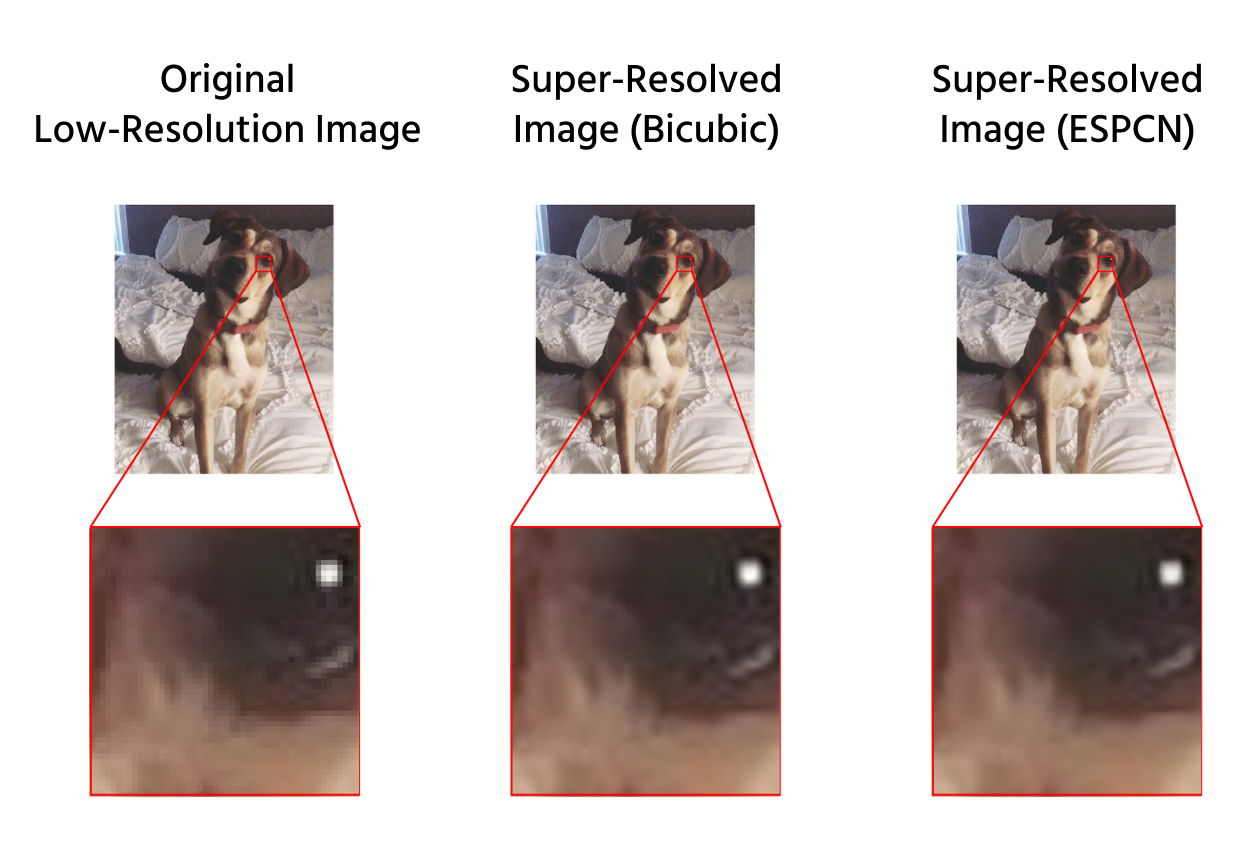
Traditional Interpolation-Based Methods
Interpolation is one of the simplest approaches to super-resolution, where missing pixels are estimated based on surrounding pixel values. All common interpolation techniques include cv2.resize(), but the interpolation parameter differs:
super_res_image = cv2.resize(image, None, fx=4, fy=4, interpolation=interpolation_param)
Nearest-Neighbor Interpolation
- Copies the closest pixel value to the new location;
- Produces sharp but blocky images;
- Fast but lacks smoothness and detail.
interpolation_param = cv2.INTER_NEAREST
Bilinear Interpolation
- Averages four neighboring pixels to estimate the new pixel value;
- Produces smoother images but can introduce blurriness.
interpolation_param = cv2.INTER_LINEAR
Bicubic Interpolation
- Uses a weighted average of 16 surrounding pixels;
- Provides better smoothness and sharpness compared to bilinear interpolation.
interpolation_param = cv2.INTER_CUBIC
Lanczos Interpolation
- Uses a sinc function to calculate pixel values;
- Offers better sharpness and minimal aliasing.
interpolation_param = cv2.INTER_LANCZOS4
While interpolation-based methods are computationally efficient, they often fail to restore fine details and textures.
Deep Learning-Based Super-Resolution
Pretrained Super-Resolution Models:
- ESPCN (Efficient Sub-Pixel Convolutional Network): Fast and efficient for real-time SR;
- FSRCNN (Fast Super-Resolution CNN): A lightweight network optimized for speed;
- LapSRN (Laplacian Pyramid SR Network): Uses progressive upscaling for better details.
 # Load pre-trained model
sr = cv2.dnn_superres.DnnSuperResImpl_create()
sr.readModel("path/to/model.pb")
sr.setModel("model_name", scale_factor)  # Using 4x upscaling

# Apply super-resolution
high_res_image = sr.upsample(image)
スワイプしてコーディングを開始
You are given an image with low resolution:
- Apply bicubic interpolation method with 4x scale and store result in
bicubic_image; - Define and create deep neural network object in
srvariable; - Read model from the
model_path; - Set the name
espcnand 4x scale; - Apply DNN super-resolution method and store result in
dnn_image.
解答
 実践的な練習のためにデスクトップに切り替える下記のオプションのいずれかを利用して、現在の場所から続行する
フィードバックありがとうございます!

single
AIに質問する

AIに質問する

何でも質問するか、提案された質問の1つを試してチャットを始めてください
