Customer Journey Mapping: From Awareness to Conversion
メニューを表示するにはスワイプしてください
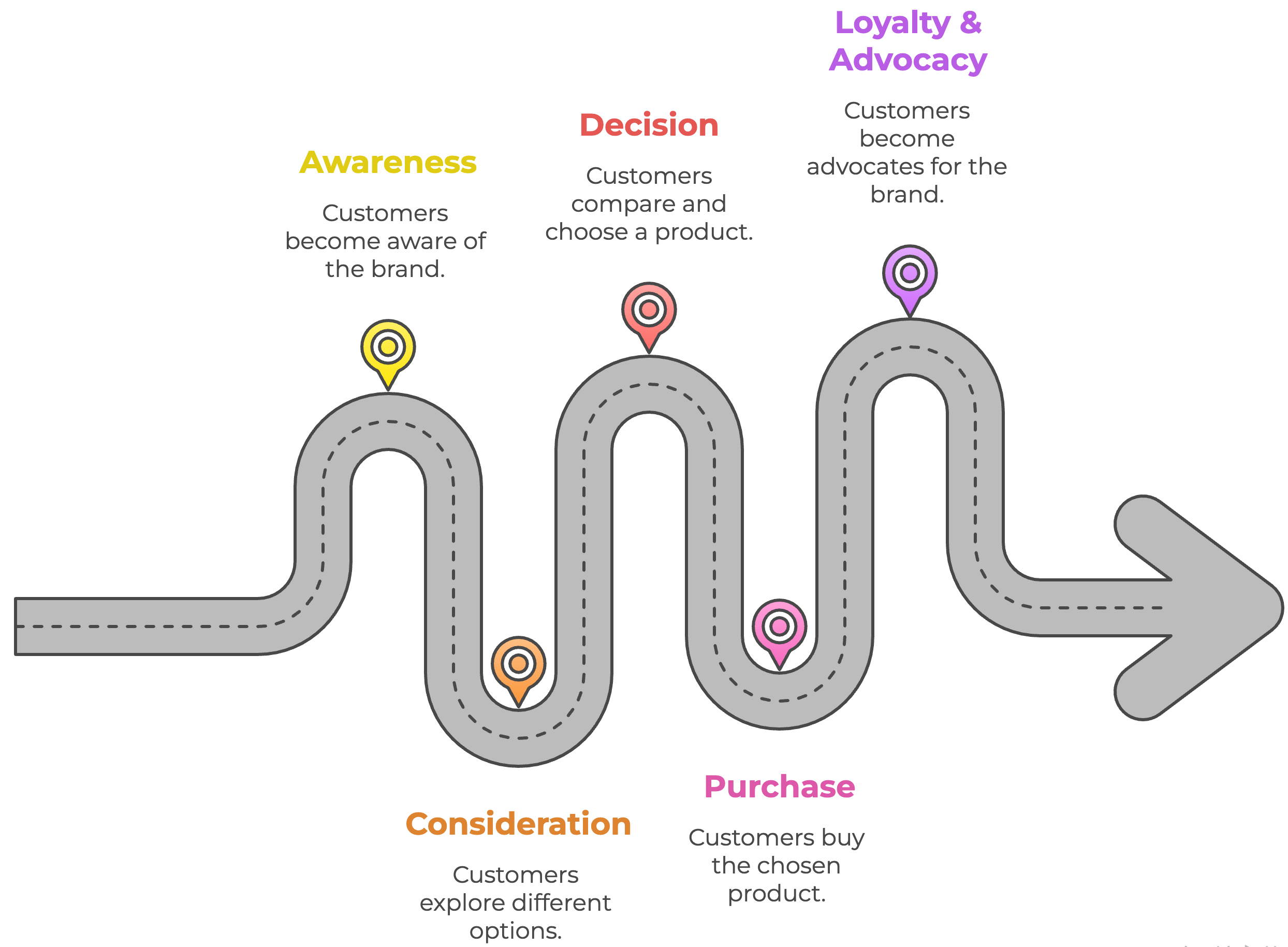
The customer journey describes the path a person takes from the moment they first encounter a brand to the point where they become a loyal customer and even recommend the brand to others.
Instead of random marketing actions, a structured customer journey allows marketers to design coordinated touchpoints that guide users toward conversion.
Main Stages of the Customer Journey
Common Attribution Models
Because customers interact with multiple channels before converting, marketers use attribution models to determine which touchpoints contributed to the final purchase.
- First-touch: credit goes to the first interaction;
- Last-touch: credit goes to the final interaction;
- Linear: credit distributed evenly across interactions;
- Time decay: interactions closer to conversion receive more credit.
Example Journey
A typical digital marketing journey might look like this:
- User discovers brand through Instagram ad;
- Reads blog article;
- Signs up for email newsletter;
- Clicks retargeting ad;
- Purchases product from website.
Each interaction plays a role in influencing the decision.
1. Which tactic most directly supports moving a customer from evaluation to commitment in the journey?
2. Which two actions most effectively strengthen the post-purchase loyalty stage? (Select two)
3. Match the marketing tactic with the stage where it is most effective:
フィードバックありがとうございます!
AIに質問する

AIに質問する

何でも質問するか、提案された質問の1つを試してチャットを始めてください
Customer Journey Mapping: From Awareness to Conversion
The customer journey describes the path a person takes from the moment they first encounter a brand to the point where they become a loyal customer and even recommend the brand to others.
Instead of random marketing actions, a structured customer journey allows marketers to design coordinated touchpoints that guide users toward conversion.
Main Stages of the Customer Journey
Common Attribution Models
Because customers interact with multiple channels before converting, marketers use attribution models to determine which touchpoints contributed to the final purchase.
- First-touch: credit goes to the first interaction;
- Last-touch: credit goes to the final interaction;
- Linear: credit distributed evenly across interactions;
- Time decay: interactions closer to conversion receive more credit.
Example Journey
A typical digital marketing journey might look like this:
- User discovers brand through Instagram ad;
- Reads blog article;
- Signs up for email newsletter;
- Clicks retargeting ad;
- Purchases product from website.
Each interaction plays a role in influencing the decision.
フィードバックありがとうございます!
