Notice: This page requires JavaScript to function properly.
Please enable JavaScript in your browser settings or update your browser.
Impara Changing Text Case | Pulizia dei dati testuali
Pulire i dati in Excel

Changing Text Case

Scorri per mostrare il menu

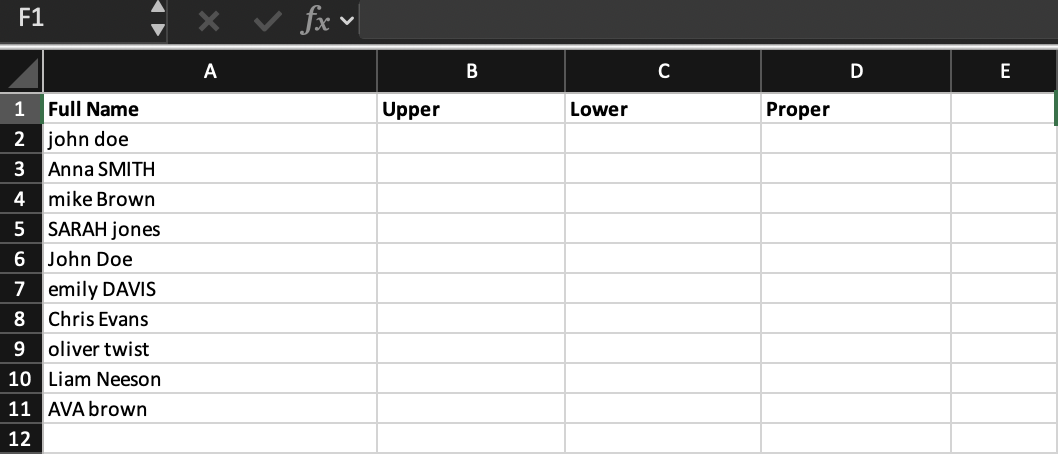
When working with text data, you will often notice that the same type of values are written in different cases. For example, one name might be written as john doe, another as JOHN DOE, and another as John Doe. Even though they represent the same value, this inconsistency makes the data look unstructured and harder to work with.

Such differences can also affect sorting, filtering, and presentation. That's why one of the important steps in data cleaning is standardizing text case.

Let's consider a simple example:

Here, all values represent names, but the formatting is inconsistent. Some are lowercase, some uppercase, and some mixed.

Text Case Functions

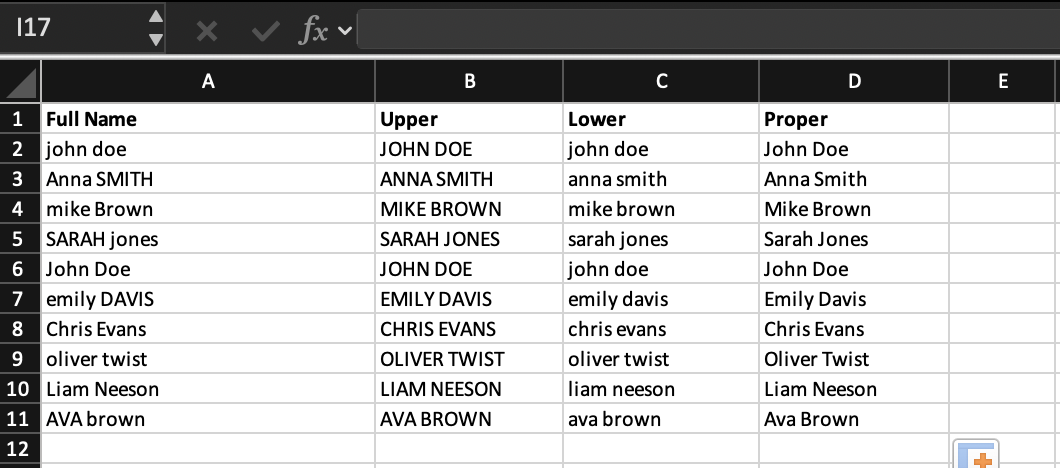
Excel provides three main functions to fix this:

UPPER → converts all text to uppercase;
LOWER → converts all text to lowercase;
PROPER → capitalizes the first letter of each word.

=UPPER(A2) → "JOHN DOE"
=LOWER(A2) → "john doe"
=PROPER(A2) → "John Doe"

In most real cases, PROPER is used for names, because it gives a clean and readable format.
carousel-imgcarousel-img

Task

Create a new column called Formatted Name.

Apply a formula to convert all values in the Full Name column into a consistent format, where each word starts with a capital letter.

Fill the formula down for all rows.

Note
Hint

Use =PROPER(A2) to capitalize each word in the text and apply the formula to all rows.

question mark

Which function converts text to "John Doe" format?

Seleziona la risposta corretta

Tutto è chiaro?

Come possiamo migliorarlo?

Grazie per i tuoi commenti!

Sezione 2. Capitolo 3

Chieda ad AI

expand

Chieda ad AI

ChatGPT

Chieda pure quello che desidera o provi una delle domande suggerite per iniziare la nostra conversazione

Changing Text Case

When working with text data, you will often notice that the same type of values are written in different cases. For example, one name might be written as john doe, another as JOHN DOE, and another as John Doe. Even though they represent the same value, this inconsistency makes the data look unstructured and harder to work with.

Such differences can also affect sorting, filtering, and presentation. That's why one of the important steps in data cleaning is standardizing text case.

Let's consider a simple example:

Here, all values represent names, but the formatting is inconsistent. Some are lowercase, some uppercase, and some mixed.

Text Case Functions

Excel provides three main functions to fix this:

UPPER → converts all text to uppercase;
LOWER → converts all text to lowercase;
PROPER → capitalizes the first letter of each word.

=UPPER(A2) → "JOHN DOE"
=LOWER(A2) → "john doe"
=PROPER(A2) → "John Doe"

In most real cases, PROPER is used for names, because it gives a clean and readable format.
carousel-imgcarousel-img

Task

Create a new column called Formatted Name.

Apply a formula to convert all values in the Full Name column into a consistent format, where each word starts with a capital letter.

Fill the formula down for all rows.

Note
Hint

Use =PROPER(A2) to capitalize each word in the text and apply the formula to all rows.

Tutto è chiaro?

Come possiamo migliorarlo?

Grazie per i tuoi commenti!

Sezione 2. Capitolo 3
some-alt