Introduction to Spring
Glissez pour afficher le menu
Now we've arrived at the most exciting part - Spring Framework, which we will be using throughout the entire course. That's why it's crucial to complete this section thoroughly and study it well!

What is Spring?

The Spring Framework is a platform for building applications in Java. It offers tools and libraries that assist developers in creating complex applications by simplifying dependency management, configuration, and many other aspects of programming.
In addition to managing dependencies, the Spring Framework also provides a range of features to help developers integrate various components, configure application behavior, and access essential services like databases and web interfaces. This makes it easier to develop scalable and maintainable applications, as many common programming tasks are streamlined or automated.
We'll take a closer look at how to manage dependencies in Spring a bit later.

The main goal of the Spring Framework is to simplify application development by providing an infrastructure that makes complex tasks easier.
What is Bean
We'll cover the topic of beans at the very beginning of this section because it's extremely important.
A bean is an object that Spring manages for you. Instead of creating and controlling these objects yourself, you let Spring handle it. Spring decides when to create the object, how to set it up, and when to remove it from memory. These objects are stored in a Spring container, which helps manage their lifecycle and dependencies, but we'll talk more about that later.
To make a object a bean so that Spring can manage its lifecycle, we can annotate it with @Component, @Service, @Repository, @Controller (we will look at these annotations later)
@Component
public class Car {
    // Your code here
}
You'll see how simple this process is and the advantages it offers for future development.
What Are the Main Modules and Their Responsibilities?
In Spring, a module is a separate part of the framework responsible for a specific set of functionalities or features. Each module provides specialized capabilities, such as security, data management, or web programming.
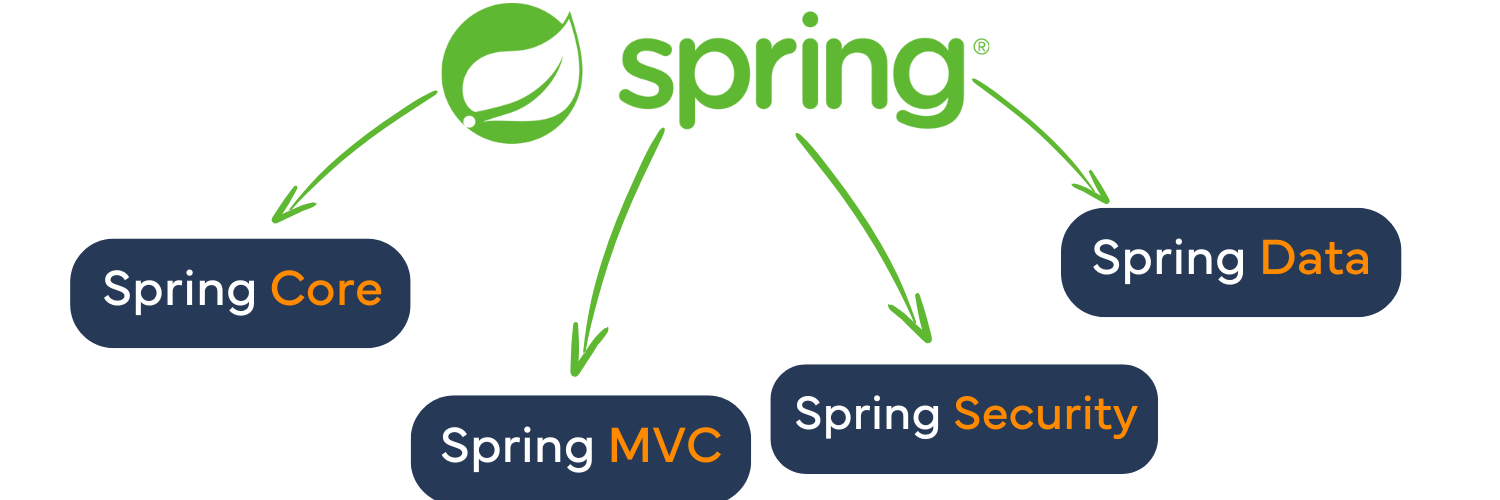
Spring Core is the central part of the Spring framework. It includes the essential features and the IoC (Inversion of Control) container, which is a special tool that manages the objects in your application, known as bean, which we have already discussed;
Spring MVC (Model-View-Controller) is a framework for creating web applications. It helps you organize your code by separating different parts of your application. We’ll take a closer look at it in this section;
Spring Security ensures the security of applications. It provides tools for authentication (verifying user identity) and authorization (determining user permissions to perform certain actions);
Spring Data is a module that provides simplified access to databases and repositories. It offers a unified way to work with various data sources (such as SQL, NoSQL, in-memory databases).
What is Spring Boot?
Spring Boot is a tool built on top of the Spring Framework that simplifies the creation and deployment of applications by minimizing the required configuration. It provides embedded servers, automatic configuration of components, and a variety of starter templates, enabling you to quickly start new projects.
The key difference is that Spring provides the core functionality and flexibility for building applications, while Spring Boot makes the process easier by offering automatic configuration and reducing the amount of manual setup required.
It’s important to understand that Spring Boot is not a separate framework; rather, it's an additional module, like Core, that streamlines the setup process and minimizes configuration work.
That’s why we will be using Spring Boot throughout the course, as it is much easier to set up.
1. What is Spring Boot?
2. What is Spring Data?
Merci pour vos commentaires !
Demandez à l'IA

Demandez à l'IA

Posez n'importe quelle question ou essayez l'une des questions suggérées pour commencer notre discussion
