What are Maps?
Desliza para mostrar el menú
Maps are an implementation of hash maps in Golang. A hash map is a data structure that maps keys to values, where a key can be a value of a comparable data type, such as int, float, string, and so on. Values can range from simple string literals to arrays.
Note
In Go, a comparable datatype refers to a data type that supports comparison operations, such as equality and ordering. Comparable types are those that can be compared using the equality operators (
==and!=) and the relational operators (<,<=,>,>=).
Below is a diagram representing a hash map:
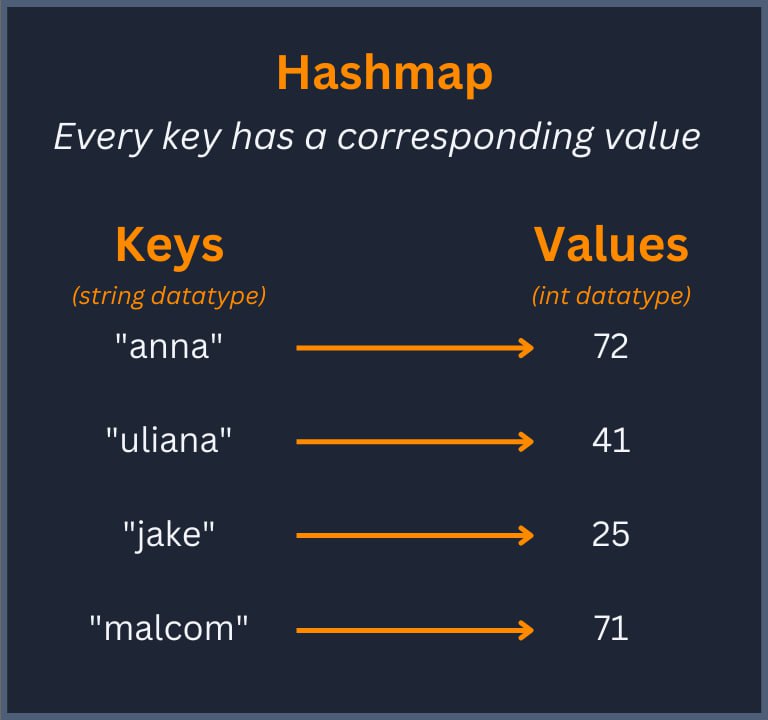
In arrays, we use indexes to access the stored data at an index. In contrast, with maps, we use keys to access the corresponding values.
¡Gracias por tus comentarios!
Pregunte a AI

Pregunte a AI

Pregunte lo que quiera o pruebe una de las preguntas sugeridas para comenzar nuestra charla
What are Maps?
Maps are an implementation of hash maps in Golang. A hash map is a data structure that maps keys to values, where a key can be a value of a comparable data type, such as int, float, string, and so on. Values can range from simple string literals to arrays.
Note
In Go, a comparable datatype refers to a data type that supports comparison operations, such as equality and ordering. Comparable types are those that can be compared using the equality operators (
==and!=) and the relational operators (<,<=,>,>=).
Below is a diagram representing a hash map:
In arrays, we use indexes to access the stored data at an index. In contrast, with maps, we use keys to access the corresponding values.
¡Gracias por tus comentarios!
