Introduction to Caching
Swipe um das Menü anzuzeigen


We'll explore how Redis is used for caching and why it’s such a popular choice. For testing and development, we'll use Spring Boot as the server framework.

To follow along with the examples in this section, you should have a basic understanding of Spring Boot and Java.
How does caching work?
-
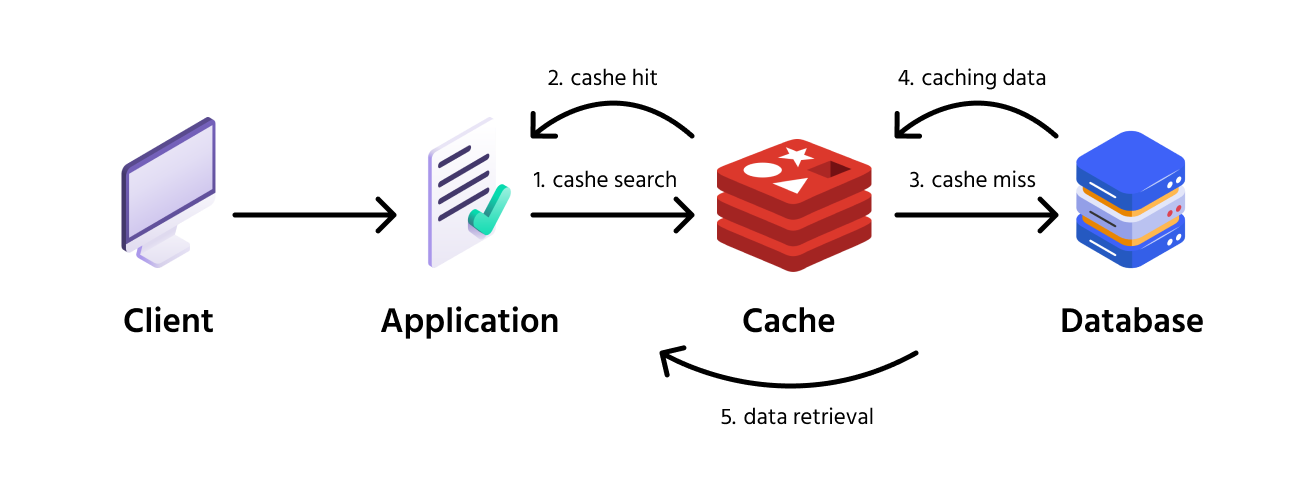
When a user sends a request, the server first checks if the required data is in the cache (Redis);
-
If the data is in the cache (cache hit), it is immediately returned to the user;
-
If the data is not in the cache (cache miss), the server retrieves it from the database;
-
The retrieved data is then stored in the cache for future use;
-
Finally, the data is returned to the user.
Spring is just one example of how Redis can be used. Developers building backends with other languages or technologies can also integrate Redis seamlessly into their projects.
What’s next?
In this section, we'll build an application integrated with Redis to demonstrate how caching works. We'll create a simple REST API and evaluate its performance with caching enabled.
Caching not only improves response times for users but also reduces database load, making the application more scalable.
Danke für Ihr Feedback!
Fragen Sie AI

Fragen Sie AI

Fragen Sie alles oder probieren Sie eine der vorgeschlagenen Fragen, um unser Gespräch zu beginnen
