Indexes
Let's consider how to work with arrays. First, let's understand how to access specific elements in an array.
To access a specific element in an array, use square brackets with the index. Remember that the index is not the actual position of the element, as indexing in PHP starts from 0. Let's look at an example for clarity.
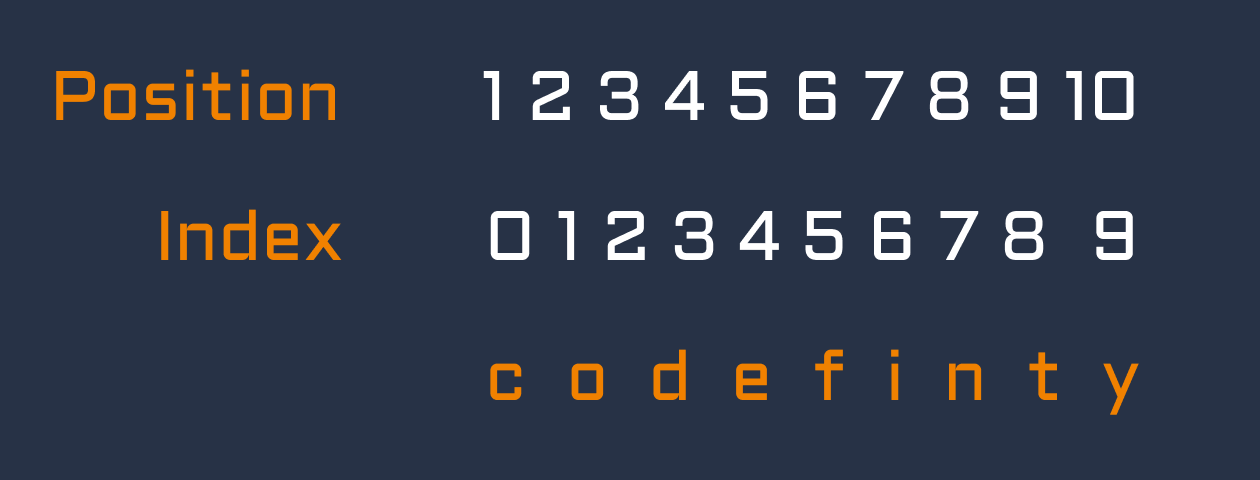
The index is always one less than the actual position. For example, we can retrieve several elements from an array in the example below:

main.php
1234567<?php // Initial array $site = ["c", "o", "d", "e", "f", "i", "n", "i", "t", "y"]; // Getting letters 'o' and 'y' echo $site[1] . " " . $site[9]; // outputs 'o y' ?>
In this example, the array $site contains the letters of the word "codefinity". We use numerical indices to access specific letters.
String Indexes
In PHP, just like arrays, strings also have indexes starting from zero. This means you can access each individual character of a string by its index, similar to how you work with elements in an array. For example, in the string $string = "Hello";, the character 'H' has index 0, 'e' has index 1, and so on. You can access characters using square brackets like $string[0] will give you 'H', or curly braces like $string{0} will also give you 'H'. This allows you to manipulate individual characters in a string as easily as elements in an array.
main.php
1234567<?php // Initial array $string = "Hello"; // Getting letter 'H' echo $string[0]; // outputs 'H' ?>
Danke für Ihr Feedback!
single
Indexes
Swipe um das Menü anzuzeigen
Let's consider how to work with arrays. First, let's understand how to access specific elements in an array.
To access a specific element in an array, use square brackets with the index. Remember that the index is not the actual position of the element, as indexing in PHP starts from 0. Let's look at an example for clarity.
The index is always one less than the actual position. For example, we can retrieve several elements from an array in the example below:
main.php
1234567<?php // Initial array $site = ["c", "o", "d", "e", "f", "i", "n", "i", "t", "y"]; // Getting letters 'o' and 'y' echo $site[1] . " " . $site[9]; // outputs 'o y' ?>
In this example, the array $site contains the letters of the word "codefinity". We use numerical indices to access specific letters.
String Indexes
In PHP, just like arrays, strings also have indexes starting from zero. This means you can access each individual character of a string by its index, similar to how you work with elements in an array. For example, in the string $string = "Hello";, the character 'H' has index 0, 'e' has index 1, and so on. You can access characters using square brackets like $string[0] will give you 'H', or curly braces like $string{0} will also give you 'H'. This allows you to manipulate individual characters in a string as easily as elements in an array.
main.php
1234567<?php // Initial array $string = "Hello"; // Getting letter 'H' echo $string[0]; // outputs 'H' ?>
Wischen, um mit dem Codieren zu beginnen
Fill in the blanks in the code. Access the second element of the array ($array) and print it to the screen.
Lösung
 Wechseln Sie zum Desktop, um in der realen Welt zu übenFahren Sie dort fort, wo Sie sind, indem Sie eine der folgenden Optionen verwenden
Danke für Ihr Feedback!
single
Fragen Sie AI

Fragen Sie AI

Fragen Sie alles oder probieren Sie eine der vorgeschlagenen Fragen, um unser Gespräch zu beginnen
