Risk-Free Rate
Swipe to show menu
Every investment return gets measured against a baseline – the return you could earn by taking zero risk. That baseline is called the risk-free rate.
In practice, the risk-free rate is the yield on short-term U.S. Treasury bills. The U.S. government has never defaulted on its debt, so T-bills are treated as the closest thing to a guaranteed return that exists in financial markets.
If an investment can't beat the risk-free rate over the long run, there's no rational reason to take on its additional risk.
Why It Matters for Every Decision
The risk-free rate isn't just a number on a Bloomberg terminal. It's the silent benchmark behind every investment you evaluate.
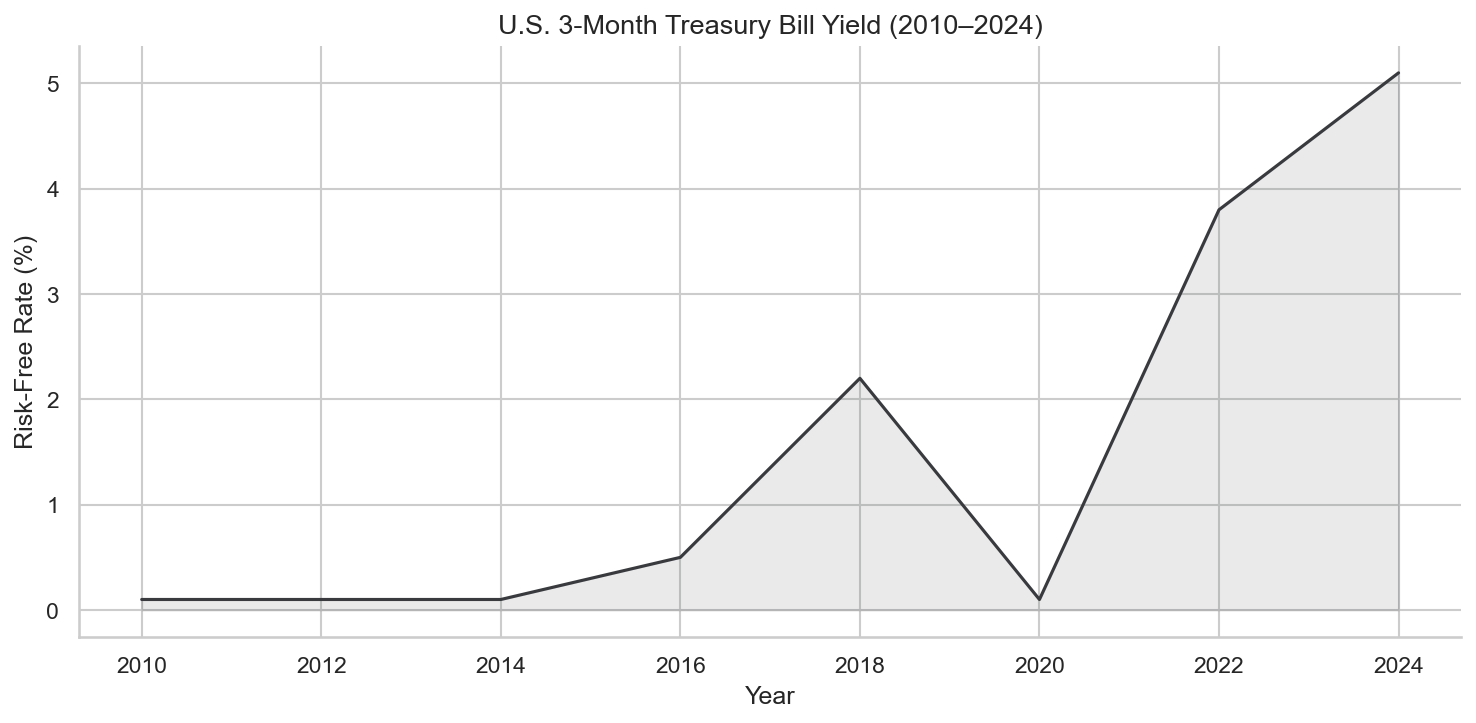
When the risk-free rate is low (near zero, as it was 2010–2021), even modest returns from stocks look attractive by comparison. When it's high (as in 2023–2024), suddenly a Treasury bill paying 5% makes riskier assets much harder to justify.
- A low risk-free rate pushes investors toward riskier assets in search of return;
- A high risk-free rate makes safe assets genuinely competitive;
- Every expected return should be compared against the current risk-free rate before making a decision.

The return an investor can earn with zero default risk, typically represented by the yield on short-term U.S. Treasury bills. It serves as the baseline against which all other investment returns are measured.

T-bills carry no default risk, but they still carry inflation risk. If the risk-free rate is 4% and inflation is 5%, your real return is negative. "Risk-free" refers specifically to credit risk – the risk that the borrower won't pay you back.

The risk-free rate moves in lockstep with the Federal Reserve's federal funds rate. Understanding how the Fed sets rates explains why the risk-free rate was near zero for a decade and jumped to 5%+ in just 18 months after 2022.
1. The risk-free rate rises from 1% to 5%. How does this most likely affect investor behavior?
2. An investor is evaluating a corporate bond yielding 4.5%. The current risk-free rate is 5.1%. What is the most rational conclusion?
Thanks for your feedback!
Ask AI

Ask AI

Ask anything or try one of the suggested questions to begin our chat
