Finding Sources with Deep Research and Discover
Swipe to show menu
A grounded tool has an obvious weakness at the start. It is useless until you have sources, and gathering sources is the slow part. Two features solve that from inside the notebook.
Discover
Describe the topic and Discover proposes around ten web sources that fit it. You review the list, pick the ones that look credible, and add them to the notebook in one step. It is the fast option when you know roughly what you are looking for and just need the links.
Deep Research
Deep research is the heavier option. It behaves like an agent: it plans, searches the open web across many pages, and comes back with a cited report plus the sources behind it, which you can then import into the notebook.
The order of operations is what makes this powerful. Research first to assemble a credible source set, then ground everything else on it. What starts as an empty notebook becomes a curated library in one run.
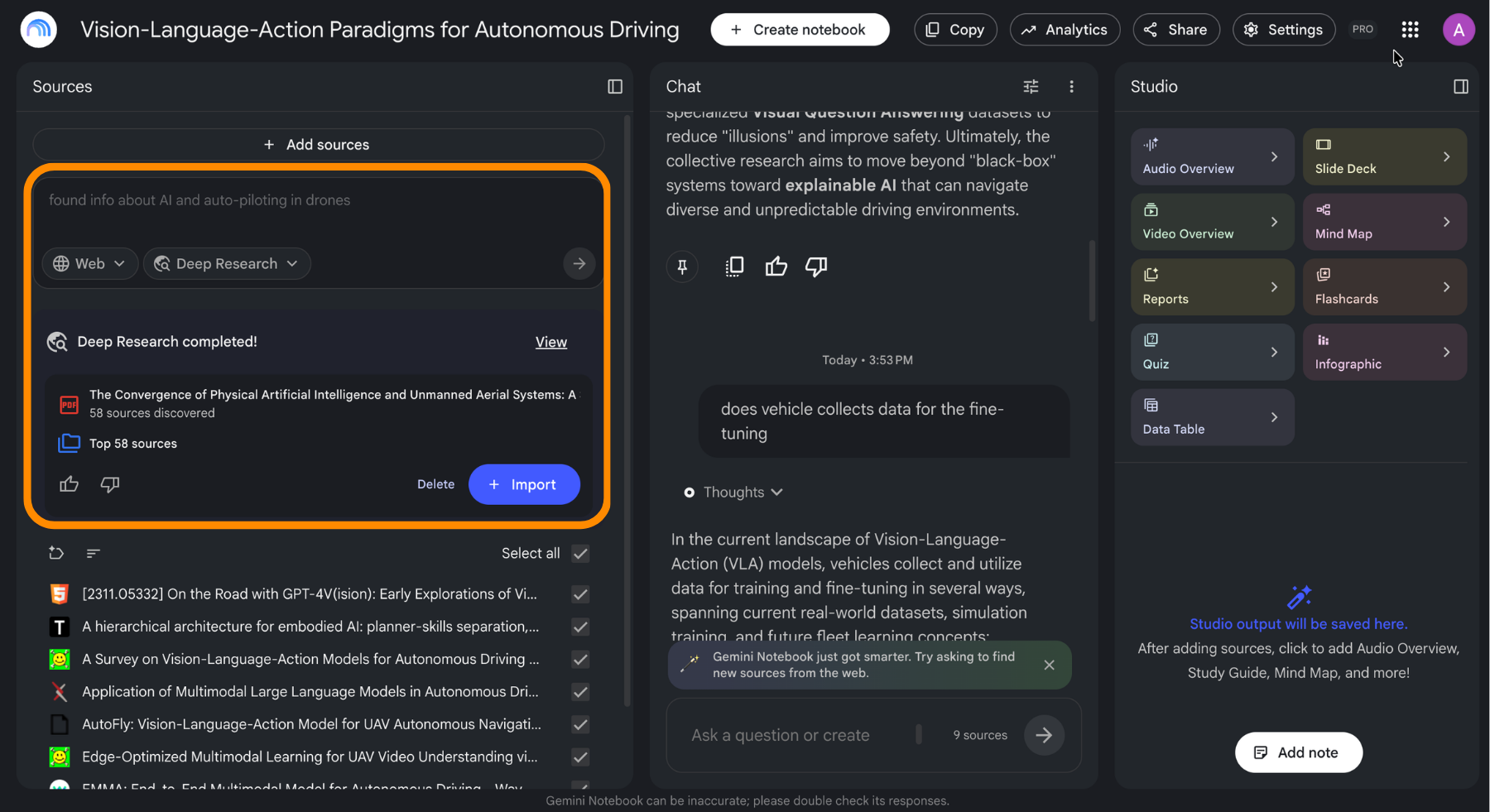
Free accounts get a small monthly allowance of deep research runs, and paid tiers move that to a daily allowance, which is the difference between using it occasionally and using it as a default first step.

A source discovered automatically is still just a web page. The citation tells you where a claim came from, not whether that page was worth trusting, so skim what gets added before building on it.
Thanks for your feedback!
Ask AI

Ask AI

Ask anything or try one of the suggested questions to begin our chat
Finding Sources with Deep Research and Discover
A grounded tool has an obvious weakness at the start. It is useless until you have sources, and gathering sources is the slow part. Two features solve that from inside the notebook.
Discover
Describe the topic and Discover proposes around ten web sources that fit it. You review the list, pick the ones that look credible, and add them to the notebook in one step. It is the fast option when you know roughly what you are looking for and just need the links.
Deep Research
Deep research is the heavier option. It behaves like an agent: it plans, searches the open web across many pages, and comes back with a cited report plus the sources behind it, which you can then import into the notebook.
The order of operations is what makes this powerful. Research first to assemble a credible source set, then ground everything else on it. What starts as an empty notebook becomes a curated library in one run.
Free accounts get a small monthly allowance of deep research runs, and paid tiers move that to a daily allowance, which is the difference between using it occasionally and using it as a default first step.
A source discovered automatically is still just a web page. The citation tells you where a claim came from, not whether that page was worth trusting, so skim what gets added before building on it.
Thanks for your feedback!
