How Transformers Classify Text
Swipe to show menu
Transformers have become a powerful tool for text classification, enabling you to process and interpret language data with remarkable accuracy. To use a Transformer for classification, you first convert input sentences into a format the model understands. Each word or token in the sentence is mapped to a unique identifier, and these identifiers are then transformed into embeddings. These embeddings, combined with positional encodings, are passed through the Transformer's encoder layers.
For classification, you typically add a special token - often called the classification token or "[CLS]" - to the start of each input sentence. The output embedding corresponding to this token is treated as a summary of the entire sentence. After the Transformer processes the input, this summary embedding is passed to a feed-forward layer or a simple classifier, such as a fully connected neural network, which outputs a probability distribution over possible classes.
Interpreting the Transformer's output involves examining both the predicted class and the model's attention weights. The predicted class tells you which category the input most likely belongs to, while the attention weights reveal which words or tokens the model focused on most when making its decision. This helps you understand not only what the model predicts, but also why it made that prediction.
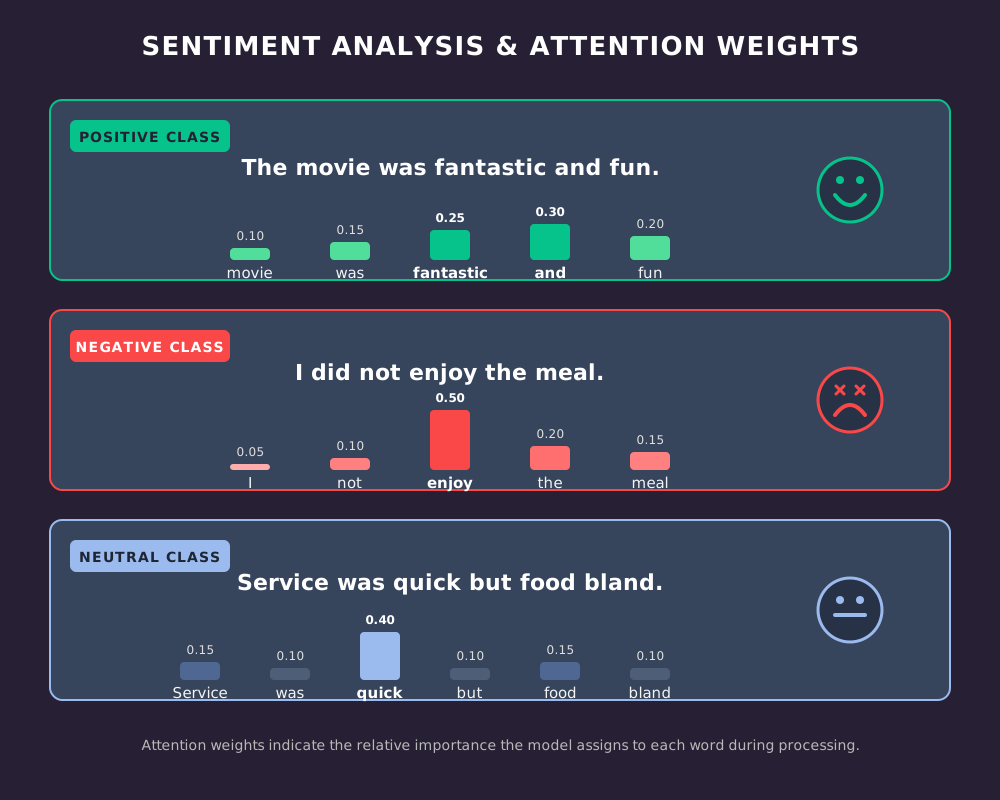
Each attention weight corresponds to a word in the sentence (excluding the [CLS] token). Higher attention weights show which words the model considered most important for its classification. For instance, in the second sentence, the word "not" receives the highest attention, highlighting its strong influence on the negative prediction.
Thanks for your feedback!
Ask AI

Ask AI

Ask anything or try one of the suggested questions to begin our chat
